Extending my earlier pick list, here are 40 classic D&D modules ranked from best to worst. I hold a classic to be a module published between the late '70s and the middle of 1983. These were the days of brilliant sandbox designs, before the concept of adventure paths took over and railroaded players into pre-determined stories. In the old-school, plotting was mostly left to the DM and stories grew spontaneously in game play. Players could make their own decisions, and DMs were trained to expect the unexpected. This was also the era of pulp fantasy, when D&D was under heavy influence of writers like Fritz Leiber (Fafhrd & Grey Mouser), Robert Howard (Conan), H.P. Lovecraft (Cthulhu), Michael Moorcock (Elric), Clark Ashton Smith (Averoigne), and Jack Vance (The Dying Earth). In simple terms, pulp fantasy involves morally ambiguous heroes who tend to face personal or localized threats out of self-interest. This is opposite high fantasy (some would say cheese fantasy), where heroes are worldly saviors, the most obvious example being Dragonlance which took over the game in 1984.
Mixed in with the TSR classics are others I feel compelled to include: four Judges Guild modules, two from Dragon magazine, and a special module published recently by the guru of old-school RPGs, James Maliszweski. If not for James and his Grognardia blog, I doubt my passion for D&D would have ever been reignited.
 (1) Tomb of Horrors. 5+ stars. Gary Gygax, 1978. Levels 10-14. The mother of all killer dungeons is revered by everyone, even victims who insist otherwise. It gave DMs a license to be ridiculously unfair and players the okay to be masochistically thrilled by impossible challenges. You really have to embrace the futility of going against the demi-lich, provided you can reach that point, which is highly unlikely. Multi-layered traps and demonic snares are in play everywhere, and some of the rooms have acquired mythic status: The Forsaken Prison, The Chapel of Evil, The False Crypt, The Chamber of Hopelessness. I get chills thinking of them and the disturbing illustrations provided in the special booklet. No other dungeon has called forth the level of commentary that continues to this day, ranging from the outraged to the venomous to the heapingly sarcastic (my favorite is the cover parody carrying the label "For Advanced Sadists & Masochists"), but what's interesting is that the only reason Tomb of Horrors even exists is because players were complaining that the game was getting too easy. It's hard to imagine how D&D would have evolved if not for those complaints, but there's no question that Gygax is remembered for his response to them, this module, more than any other. When he died in 2008, it was even suggested as a tribute to start a fund for a mausoleum based on the tomb's layout, and I can't imagine a more appropriate honor. The '90s sequel, Return to the Tomb of Horrors, is frankly just as good (and twice as deadly), and may be considered an honorary tie at first place.
 (2) The Lost City. 5+ stars. Tom Moldvay, 1982. Levels 1-3. A close second on my list, and I could almost award it the top slot for being a beginner's module. It's hard to come up with top-notch low-level adventures, but The Lost City is so inspired that I never resented the fact that the city itself leaves much for the DM to develop; I bought into the pyramid so much that the rest flowed without thinking. The module in many ways epitomizes what the Golden Age of D&D had to offer: pulp fantasy at its purest, depicting an ancient underground civilization that's been corrupted by a Cthulhu-like deity monster. The three renegade factions adhere to the old gods, but they don't like each other, and are capable of using the players as pawns. The revolving passage on the third tier of the pyramid is one of my favorite dungeon features, and the personalities of the cult leaders, their costume attire and masks, are spot on, meshing perfectly with the decadent civilization of the Cynidiceans. The influence of Howard's Red Nails is often talked about, and the hallucinogenic drug-addicted devotees of Zargon are exactly the sorts Conan would find himself going against. I'll never forget my friend's reaction when his characters confronted the high priest beside the underground lake, and I had the fanatic cast an earthquake spell. (I think he thought I was as psychotic as the priest.) There is endless potential in The Lost City for follow-up adventures, and at one point I harbored ambitions to develop an entire series out of it.
 (3) Castle Amber. 5 stars. Tom Moldvay, 1981. Levels 3-6. Another Moldvay treasure, but in this one I was the player. The Amber family are a lot like a warped version of Tolkien's elves: "The Ambers live magically lengthened lives, but they have seen too much and are bored. They seek anything to relive this boredom." Equally amused by the success or deaths of anyone working against them (for "a good spectacle" is more important than victory or defeat), their chaotic indifference disturbs more than the evil of traditional foes. No other module on this list boasts so many colorful and psychotic characters: the librarian Charles who buried his sister Madeline alive; the soul of Princess Catherine waiting to possess someone; the evil priest Simon; Madam Camilla who is itching to tell fortunes. Also, no other module offers so much with such effortless economy. First, there's the castle itself, with two large wings, an indoor forest, and a chapel, and not a room is wasted; second comes a challenging dungeon with well planned surprises, ending at a magical gateway to -; third, the old home of the Ambers on an alternate prime material plane resembling medieval France, where the players must acquire four artifacts to return to - ; fourth, the tomb of Stephen Amber himself, where lies the means to break the curse of the castle. Moldvay hit a home run like he did with The Lost City, and I would probably call Castle Amber the most rewarding D&D adventure I ever experienced as a player.
 (4) Vault of the Drow. 5 stars. Gary Gygax, 1978. Levels 10-14. Some modules don't age well as you get older, and Queen of the Demonweb Pits is the best example of this. Others do the opposite, and for me Vault of the Drow has appreciated in value more than any module in the history of D&D. I never got proper use out of it for two reasons. First because it falls in the worst place possible in a long series, penultimately trailing five dungeon crawls, and by this point characters are burning to get to the Abyss to which Vault of the Drow serves as a mere doorstop. The second reason feeds into the first. This is an underground city, not a dungeon, and with enough care can be mostly sidestepped by those not interested in lingering. And that's a shame, because this is a realm to be milked and savored for all its worth. The descriptive writing on display is nothing less than brilliant, and DM's who know what they're doing can serve up an incredibly haunting world where factions of dark elves plot against each other, demons and undead walk the streets, and obscene sacrifices are offered to the goddess Lolth -- all under the purple glow of phosphorescent fungi and a bizarre "moon" of shimmering amethyst. There are torture parlors, bordellos, and drug saloons, but everything is ironically civilized and disturbingly beautiful. If I were running this today I'd use it as a stand-alone, with the aid of the amazing background provided in Dragon issue #298. It's a module I wish I'd known how to manage better, and appreciate better, in my gaming years. Now I get chills just reading it.
 (5) Expedition to the Barrier Peaks. 5 stars. Gary Gygax, 1980. Levels 8-12. Robots and laser guns come to D&D. There are some who decry any injection of science fiction into fantasy, and I tend to be like that myself, but when done occasionally, and when the sci-fic elements are treated as completely alien, it can work. Expedition to the Barrier Peaks works wonders. I could go on about the mileage I got out of this module, especially as a player in taking over the crashed ship -- by acquiring the color-coded cards that key open restricted areas and give one authority over the robots. It's essentially about fantasy characters going wild with their fantasies of super technology, and the stunning visual aids help tremendously on this point. The uniquely designed blaster pistols, blaster rifles, laser pistols, laser rifles, needle guns, paralysis guns, various grenades, and powered armor are etched in my mind forever, and you pretty much need a lot of this stuff to have any hope in taking on the alien forces infesting the ship. Provided you can figure out how to use them: there are flow-charts determining this, and high intelligence scores are much advised to guard against shooting oneself. Expedition to the Barrier Peaks represents a clash of genres which should be emulated perhaps once a decade; when done right, the result kicks ass.
 (6) Inferno. 5 stars. Geoffry Dale, 1980. Levels 12-16. There aren't many old-school modules set in the outer planes, and what DM doesn't want to send his players straight to Hell? This is actually still a work in progress after 30 years: the module itself covers Hell's first four circles, a modern magazine presented the fifth and sixth just a few years ago, and apparently Dale is still working on the others for a full-blown Gazeteer of Hell. I can't wait to see the finished product. The descriptive writing on display in this classic is staggering, especially some of the scenes of souls being tortured. As a Judges Guild product, it's old-school to the core and sets an absolutely perfect tone. The leering devil who rapes female PCs before killing them is a typical reminder of how faithful modules were (especially JG ones) to the essence of pulp fantasy before D&D became so sissified. Some of the most vile magic items can be found here, many cursed, as well as hidden talismans that can be used against the dukes. Inferno obviously owes to Dante, especially in terms of the tour-guide approach (duke rulers like Plutus can be receptive enough to show PCs around torture pits where souls labor in degrading tasks), and I adore the medieval Christian overtones; they complement D&D's ancient pagan mythology instead of clashing with it.
 (7) Caverns of Thracia. 5 stars. Paul Jaquays, 1979. Levels 2-4. I wish I'd been exposed to more Judges Guild products in my teen years; they remain the strongest reminder of how authentic D&D was before the game became so Disneyfied in the mid-'80s. According to Jaquays, JG gave him freedom to design modules as he pleased, while TSR had a stiffer code of ethics regarding "adult content". Caverns of Thracia and Dark Tower are his mighty achievements, and I'm hard pressed to say which is better, though the former tips the scales. Its influence on Moldvay's Lost City is evident, with the clash of civilizations in an underground realm layered with chaotic history. The lizard men trying to reclaim their kingdom are strangely reminiscent of the Silurians in Doctor Who; their human rivals evoke the warrior culture of ancient Greece. There's a revived shrine, hidden tombs with undead, beastmen serving a minotaur, and even an incarnation of Thanatos (Death) prowling about to claim the unwary. It's a dungeon of ancient atmosphere and hidden knowledge, with brilliantly detailed maps (both 2D and 3D) of maze-like connections (stairs, shafts, and chutes) that PCs must figure out. I really wish there were more modules like Caverns of Thracia.
 (8) Dark Tower. 5 stars. Paul Jaquays, 1979. Levels 7-11. Again we have rival factions warring within an enclosed space, this time the priesthoods of Mitra and Set, and the towers of both are buried under a creepy village isolated from the rest of the world. It's a punishing underground of sadism and sacrifice, and even the village is saturated in horror: its inhabitants are over 300 years old, cursed by immortality and unable to leave the mountain pass; dominated by the Set cult, hardly able to recall a time of law and goodness under Mitra's power. Avvakris the Merchant (who is actually the high priest of Set) is one of the most memorable villains from any D&D module, his son a half-reptilian, and his concubine a ravishing beauty who can either be found making love to him or as a half-eaten corpse with her heart removed. The juxtaposition of evil and good forces in the underground lends such power to Dark Tower in a way that's hard to describe. It's one of those modules that captures a unique air with uniquely demented rooms, like the Hall of the Warring Doors, and the throne hall where Set's own son awaits... along with the lich who has cursed the village. PCs could ally themselves with either the Mitra or Set faction, depending on their alignment of course, and that's highly advisable given that so much death can be expected here.
 (9) Ravenloft. 5 stars. Tracy and Laura Hickman, 1983. Levels 5-7. The middle of '83 is when everything changed: inferior cover designs, railroady adventures, the inception of the dreaded Silver Age. But before ruining everything with Dragonlance, the Hickmans came up with this little terror, and as much as I hate to include them on a list of favorites, there's just no denying that Ravenloft is plain awesome. In the opinion of many, in fact, it's the #1 module of all time. It's Dracula in a D&D setting and saturated with gothic menace. The premise involves an isolated community under terror, and anyone who enters the vale cannot leave: once you breathe Barovia's enchanted atmosphere, your life depends on it, and killing the vampire Strahd is the only way to dispel the fog. The castle of Ravenloft itself is superb, infested with bats, wolves, and various undead in thrall to the vampire, and the teleport trap protecting Strahd's coffin is genius (exchanging someone who passes through the crypts for the undead body of a wight who then assumes the character's attire and possessions, while the poor fool goes inside the wight's coffin; to the other players, it simply looks like the character has turned into a wight). As with Stoker's classic, there's a tragic backdrop to the vampire's story, and if the players succeed in killing him, it's a true mercy. The module makes good use of "fortune" through the gypsies of Barovia, whose card readings result in different scenarios each time the module is used. The black-and-white visuals evoke the mood perfectly. Beyond doubt, Ravenloft is the best undead adventure ever made.
 (10) The Dancing Hut. 5 stars. Roger Moore, 1984. Levels 9-14. Any pick list that doesn't include Baba Yaga is instantly disqualified -- which pretty much means every list out there. I don't know if it's because it was officially published in The Dark Age of D&D that it gets overlooked, but Roger Moore's original version came a decade earlier, in Dragon magazine #83. Both versions are excellent, and while I believe Moore's is superior, I can't fail to mention the wonderfully perverse trap from Lisa Smedman's '95 in which players walk into their own intestines and can be digested by themselves. The hut is basically a TARDIS for fantasy instead of science-fiction, meaning that its interior is huge and dimensionally folded to allow seemingly impossible interconnections. There are 48 rooms, some as big as palace halls, built around a four-dimensional tesseract structure (think of eight cubes joined together along their faces), and a lot of twisted ingenuity went into populating them. The '95 version revolves around a dramatic plot of Baba Yaga in control of daylight and darkness on any world she visits in her quest for immortality, but I prefer the more primal backdrop in the '84 version, which simply involves the old crone terrorizing country-sides, kidnapping and eating people. I love the fact that Baba Yaga will never harm children, the weak, and low (1st)-level characters, not out of sympathy (she's evil to the core), but out of superstitious fear of being cursed for attacking the helpless. The Dancing Hut is punishing, ruthless, and one hell of a rollercoaster ride.
 (11) The Village of Hommlet. 5 stars. Gary Gygax, 1979. Levels 1-3. At first blush this is just a village serving as a base for an expedition to an evil temple described in another module. But there's nothing "just" about anything by Gary Gygax, and I can understand why people like James Maliszewski and Joe Bloch rhapsodize about Hommlet to no end. Says Maliszewski: "There's something powerful about this perfect set-up for a new campaign. I share with Tolkien the conception of history as a 'long defeat' and The Village of Hommlet touches on that theme obliquely -- the notion that each generation must stare Evil in the face and bar the way of its advance, even if it's ultimately just a holding action, for Evil can never truly be defeated in this life." And Bloch thinks it's literally the best D&D module of all time. I love it too, and designed a terrifying module that begins in Hommlet. There's something about a Gary Gygax module that's so richly subterranean even when focused on the mundane; this village wouldn't carry a fifth of its effect had it been penned by anyone else. It's certainly superior to what was supposed to be a smash sequel, The Temple of Elemental Evil, which frankly left me cold. And I even place it over Keep on the Borderlands, though I have a difficult time choosing between them.
 (12) The Keep on the Borderlands. 5 stars. Gary Gygax, 1979. Levels 1-3. Pure classic, this is the module DMs and players cut their teeth on back in the Golden Age, when it came packaged in the introductory boxed set. Everyone played the Caves of Chaos, and there's something fundamentally "D&D'ish" about a castle on the edge of civilization providing a base to launch forays into a network of lairs populated by various humanoids -- orcs, goblins, hobgoblins, gnolls, bugbears, even an owl bear and ogre, and an evil priest with a pet medusa to boot. By later standards (the mid-'80s and beyond), the Caves of Chaos seem almost like a videogame, in that there is no story behind the caves' inhabitants, no over-arching motivations behind the priest in the evil shrine... they're all just there, sitting in their rooms, as if obligingly awaiting D&D adventurers who want to fight them, take their treasure, and gain experience points. But these were the days when DMs took the initiative to develop their own backstories and let them develop organically, by accommodating unpredictable players who could actually decide what they wanted to do without playing into some pre-determined arc. Keep on the Borderlands sits right below Village of Hommlet, but it's really a tie; these low-level Gygax gems shine in different ways.
 (13) Beyond the Crystal Cave. 4 ½ stars. Dave Browne, Tom Kirby & Graeme Morris, 1983. Levels 4-7. Sinfully underrated, even unheard of in some circles. I can't believe it's not on more favorites lists. Porpherio's Garden is the closest thing TSR ever came to Tolkien: a Lothlorien-like domain that never sees winter, where time passes 700 times more slowly on the inside, and where an attitude of hacking and slaying will get you swiftly killed. This module was a milestone for me in showing the full potentials of role-playing that leans on verbal skills and crafty intelligence. The plot centers around a pair of aristocratic lovers who apparently got lost in the garden, haven't been seen in years, and the players are hired to find them and get them out. The problem is that the lovers have drunk from a fountain that makes them want to stay forever, and nothing, short of using force or a wish, will persuade them to leave, forcing questions about the ethics of trying to finish the job. Druids will feel like they're in heaven, as they automatically gain a level in the garden, and will naturally bond with the resident wildlife (satyrs, centaurs, unicorns, etc.). Warriors are a bit useless, and mages will be frustrated to find that many of their spells (especially fire related) won't work. And since a day inside the garden translates to two years outside, time is of the essence... or the players will be returning to a much different world. Beyond the Crystal Cave teaches some serious humility and deserves more recognition than it gets.
 (14) Descent into the Depths of the Earth. 4 ½ stars. Gary Gygax, 1978. Levels 9-14. Resonating with Cthulhu-like myths and Mesoamerican architecture, the Kuo-Toan shrine is the real feature here. The first installment in the D-series is rather bland, which is no doubt why it was eventually released as a package deal with the Kuo-Toa module, under the title of the first and given cover art for the second. That cover (click on the image to expand) remains one of my favorite of all time; I love the way the blues and greens and yellows mix, and bathe the lobster-goddess statue in a weird spiritual candor. The kuo-toa made nearly as much impression on me as the drow of the next module, with their highly regimented society of priests and assassins and brutally exotic culture; as amphibians this makes them even more intriguing. For all their practices of slavery and sacrifice, it's possible to negotiate with them if characters are shrewd. And there's a pathos to this race of fish-men clinging to their obscene sanctuary, way below the earth, raising their "fingerlings" (baby kuo-toans who can't survive outside water), carrying on worship of the Sea Mother. Gygax did a good job coming up with treasures, altars, traps, and other peculiarities one might expect to find in such a peculiar place, and I have especially fond memories DM'ing this product.
 (15) The Hidden Shrine of Tamoachan. 4 ½ stars. Harold Johnson & Jeff Leason, 1980. Levels 5-7. The format copies Tomb of Horrors to a tee, as if the authors wanted to come up with the same kind of thing for lower level characters who at least stand a chance. Players stumble on an abandoned shrine in the middle of nowhere, loaded with traps, light on treasure, and with few but formidable monsters (including a vampire). It's a great dungeon that tests the players' mettle around every corner, in memorable rooms like The Chapel of the Feathered Servant (one player fights an imaginary foe while the others are forced by a winged serpent to solve a puzzle), the Hall of the Smoking Mirrors (look into them if you dare), and the Hidden Room of the Alter-Ego (a statue duplicates the looks of one of the players and comes to life while that player turns to stone). The visual aids are splendid, and again in the same design as those in Tomb of Horrors, though with clear Central & Southern American features that give a distinctly exotic vibe -- it even puts one in mind of an Indiana Jones adventure. A quintessential example of a module from the Golden Age: there's no pre-packaged story; the dungeon itself is the exclusive platform on which the players (and DM) can build their own story, and as such it can be inserted into almost any wilderness campaign; most importantly, every room counts and contains the unexpected.
 (16) Aesirhamar. 4 ½ stars. Roger Moore, 1984. Levels 9-16. Did I have a blast with this one. Published in Dragon magazine #90, it takes place on the outer plane of Gladsheim, and has the Norse gods recruiting high level mortals to do their dirty work whilst Odin is MIA. The plot centers around a war hammer as deadly as Thor's Mjolnir, created by a couple of mischievous dwarves for a nasty-tempered giant bent on personal revenge, but I upped the ante by working this into an apocalyptic context. The hammer, if not destroyed or returned to the forces of good, would usher in Ragnarok, and Loki himself gets involved with the players. I don't think my friend appreciated the innovations -- and I know his mage thought twice about remaining a follower of Odin after this -- but it was roaring fun, and I believe the only outer plane adventure I ever ran that wasn't situated in evil regions like the Hells, Hades, or the Abyss. Moore supplemented his adventure with two additional articles about Gladsheim, one of which mapped out places like Asgard and Jotunheim, and detailed various things that were invaluable to running a scenario like this. Aesirhamar was a pure gift, for the Norse pantheon has always been my favorite, and the moral compass of its plane (chaotic neutral with good tendencies), is "the" alignment I have found most compelling.
 (17) The Sinister Secret of Saltmarsh. 4 ½ stars. Dave Browne & Don Turnbull, 1981. Levels 1-3. The following trilogy is a class-A example of a series that doesn't have railroading baggage. This is hard to do in a series approach, which is why there weren't many series modules in the old days (only becoming the norm after Dragonlance). The trilogy also scores big-time as thinking-players' modules, especially the first two where things aren't at all what they seem. This first one is the fan favorite: a haunted house that's not really haunted, and PCs ultimately become policemen when they find out that smugglers, not ghosts, reside on the cliff. It's the build up to that realization that makes Sinister Secret of Saltmarsh so exciting. DM's can instill a lot of fear if they know what they're doing, and keep players believing the supernatural is at large with the blinking lights, ghastly shrieks, and nauseating carrion. On top of this, the assassin plant in the upstairs bedroom has loads of potential, and if used subtly, can really sow confusion or even discord among the players. The second half of the adventure is more straightforward: the jig is up, the players board the smugglers' ship and discover lizard men involved with the plot, which segues into the next module.
 (18) Danger at Dunwater. 4 ½ stars. David Browne & Don Turnbull, 1982. Levels 1-4. This one may be less scary than the house on the cliff, but it's even more dangerous, as it easily invites bloodshed when diplomacy is needed. It turns out the lizard men have been arming themselves not to attack Saltmarsh, or any human settlement, but to take back their own fortress from invading sahuagin -- who are the true threat to humanity (the enemy of the third module). It's a tricky business: even PCs who reach a negotiating stage will more than likely have killed at least some lizard men before piecing clues together and will face new problems. Any treasure they've acquired will have to be returned, and the lizard-man king will impose weregild fees for any casualties among his race. Some claim that Danger at Dunwater doesn't measure up to the previous module, or that it's a dungeon wasted on pacifist strategies, but neither is true and ignores that all but the most shrewd PCs will believe the lizard men to be the evil threat until they proceed far enough through the dungeon to piece clues together. Some PCs won't even catch on at all. (If they figure out things too quickly, then the DM is doing a lousy job.) My favorite encounter area is the room where the two lizard boys are playing, having escaped the nursery; in the game I refereed, the PCs fed them treats and couldn't get rid of the little pests.
 (19) The Final Enemy. 4 ½ stars. David Browne & Don Turnbull, 1983. Levels 3-5. The last part of the trilogy is the straightforward one, but an incredibly deadly one for low-level PCs. Underwater breathing is required in two-thirds of this dungeon, and woe to the fools who don't swiftly kill any sahuagin before they can raise an alarm; underwater combat becomes just as critical. But PCs aren't supposed to seek out any combat, far less clear the dungeon (which would be a suicide mission), only to recon the three levels and report back to Saltmarsh officials who will launch war themselves. That's far easier said than done, and there are many encounter areas which will put role-playing to a test. For instance, the temple on the middle level is a nasty business, where sahuagin priestesses sacrifice young infants to a shark swimming throughout the room. These are the hatchlings who don't measure up to the rigorous physical standards of the sahuagin race, and the ritual on display is enough to sicken all good-aligned characters who in most cases won't be able to stop themselves from intervening. Taken together, the Saltmarsh trilogy is a shining example of an extended adventure that draws on players' resources in unexpected ways. David Browne (see also Beyond the Crystal Cave at #13) was a rare designer who could think outside the box without succumbing to the evils of the new school.
 (20) Against the Cult of the Reptile God. 4 ½ stars. Douglas Niles, 1982. Levels 1-3. This body-snatching adventure has sharp intrigue, and is even better than I remember. The village of Orlane has Hommlet vibes, but without feeling like a copycat, and fleshed out with remarkable detail. The plot involves a serpent cult (it seems that snake worshippers are always a hit in D&D) taking over the village by an unpleasant brainwashing process that's been going on for about a year. PCs must determine which villagers have been converted, and they can be given quite a bum steer depending on whose suspicions they take to heart: the mayor is convinced the hermit is the cause of the village's distress, and others suspect the newly arrived elves; there are plenty of wrong guesses to keep players on their toes. The village drama is nothing less than a horror-mystery thriller, and a superb prelude to the swamp dungeon full of lizard men and crocodiles (and the insidious naga with hypnotic powers). In fact, the villagers are so well fleshed out that I brandish this module as a first-rate example of how to create NPCs with compelling hidden motives. Against the Cult of the Reptile God requires a lot out of beginning players, brains as much as brawn, and the beauty is that any or all of the PCs are fair game for kidnapping and brainwashing -- they could well be up against themselves.
 (21) The Forgotten Temple of Tharizdun. 4 ½ stars. Gary Gygax, 1982. Levels 5-10. This one may not excel with content, but it's one hell of a mood piece and inspired one of my own dungeons similarly premised on a dormant evil that has the power to possess and drive people insane. The temple itself is a two-tiered pyramid with dungeons beneath, and a secret mini-level harboring potent treasures and nasty traps. The idea that characters must enact twisted rituals to progress through the temple is creepy as hell; the temple itself is the chief antagonist, defending itself against assault and penetration in insidious ways. And while some consider the final room of the Black Cyst to be anti-climactic, I love it for the non-traditional endgame involving a subtle energy force -- which of course is Tharizdun himself, trying to manifest and be set free. An efficient DM can really work on player's emotions throughout the temple, as Tharizdun's essence seeks to elicit sympathy, but also lust and greed, before killing people or driving them insane. The possibility of being trapped forever underground is very real. As a mood piece, it's the kind of module that requires some thoughtful planning before running it. It's full of dark secrets and an overlooked gem.
 (22) Master of the Desert Nomads. 4 ½ stars. David Cook, 1983. Levels 6-9. The cover design and trade dress should signal alarm, and technically the next two modules fall outside my scope which covers up to the middle of 1983. But for all the sins creeping into D&D at this time, the Nomads series is astoundingly superb, and perhaps that's no surprise given David Cook's pulp-fantasy genius. This is a desert wilderness of horrors, at the end of which waits an abbey run by (what appear to be) a benign group of monks who (in actuality) are strange undead-like creatures who show their true hideous forms when the sun goes down. The abbey is frankly one of my favorite scenarios ever designed and it plays extremely well, with a lot of nail-biting tension. What slightly rankles are the NPC encounters that happen out of nowhere in order to steer PCs in the right direction and make sure that events go as planned. Again, this foreshadows Dragonlance-like designs which orchestrated events with less accommodation for spontaneity. With a little tweaking, of course, you can ignore some of the script-slavery, and to be fair, it's not that heavy-handed. In fact, Master of the Desert Nomads and Temple of Death are the least offensive examples of the new school I know of, and their settings so strong that I have to include them high on this list.
 (23) Temple of Death. 4 ½ stars. David Cook, 1983. Levels 6-10. The sequel to Master of the Desert Nomads is a close tie, though against consensus I slightly favor the abbey over the temple. The deception behind the former adds another level of tension, appearing to be a benign sanctuary but in fact a death zone. The temple harbors no such illusions, and players know exactly what they're getting into -- the capital of a modern-Iran equivalent led by an "Ayatollah" responsible for desert raids and holy wars. Once again, there is some troublesome railroading, not least the town of Magden which instead of being a location on the map only becomes a location after the PCs visit one of the three nameless towns; i.e. to ensure that they reach "this" particular town. But as before, the railroading is minimal and forgivable in light of the excellent encounter areas and dungeon designs. The mountain pass into Hule is wild pup fantasy come to life, with alluring caverns of hallucinations, and even a ladder that ascends into a Kingdom of the Moon. As for the temple of death itself, it can be counted on to kill all but the most shrewd PCs. And the decoy of the Master's avatar is brilliant. The real Master's inanimate body resides in one of the coffins of the huge crypt, and is actually fairly accessible; few PCs ever realize this.
 (24) Dungeonland & The Land Beyond the Magic Mirror. 4 stars. Gary Gygax, 1983. Levels 9-12. These are the well-loved spin-offs of Alice in Wonderland and Through the Looking Glass, and their function depends on a good amount of meta-gaming. Meta-gaming is essentially the use of out-of-game information or resources to affect one's in-game decisions, and there's plenty of that here, though what's amusing is that such strategies will work against players as often as for them. For instance, when the herald begins charging PCs by talking about "the Queen of Hearts", players might be tempted to respond cleverly with rhymes about tarts or the knave stealing them. This will seal their fate, as the King and Queen will demand to know how they even knew of the crime. Meta-gaming is usually deemed the worst sin in RPGs, but it seems acceptable in a batshit context like Dungeonland. And make no mistake, for all the craziness, Dungeonland and Magic Mirror work wonders as high-level challenges: they
  are deadly and unforgiving. Like the Brothers Grimm, fairy tales are supposed to be scary, as most of them were until the influence of Disney. Gygax understands this and equips his psychotic NPCs accordingly. For instance, the Mad Hatter is an 8th-level monk who has an endless supply of cursed hats that he will attempt to throw on people's heads -- hat of occupation (PC believes himself to be a different class), hat of imprisonment (enlarges to cover the PC and make him immobile), hat of fools (makes the PC dance uncontrollably), etc. The March Hare is even more insane; the Cheshire Cat an omnipresent nightmare. Had Wonderland been translated into a beginner's level adventure it would have been a joke. Gygax made it a terror like Pan's Labyrinth, and there's no real purpose to it other than to ride the psychosis and see if you can survive. It's a pocket universe feeding DM sadism and PC risk addiction, and despite certain reservations I'm very fond of it.
 (25) White Plume Mountain. 4 stars. Lawrence Schick, 1979. Levels 5-10. This module hasn't aged well; in my teen years I would have easily put it somewhere in the top five (my extreme example of a module that has aged badly is Queen of the Demonweb Pits, which went all the way from #1 to #40). Don't get me wrong, I still have plenty of affection for White Plume Mountain, but there's something artificial about it that rubs me the wrong way. Also, it plays like Tomb of Horrors lite. Almost every room involves a trap, puzzle, riddle, or deadly creature -- but with an odd feel of levity, so you have PCs doing things like kayaking on a river suspended in mid-air. The premise involves recovering three magical weapons -- a warhammer, trident, and sword -- artifacts with memorable personalities, and powerful ones at that. It's interesting how the module came into being: Lawrence Schick wrote it while applying to work for TSR, and he simply cobbled together the best parts of his previous dungeons. It definitely has a patchwork feel to it, and obviously the sword Blackrazor is a rip-off of Elric's Stormbringer (which frankly I love). One of my players ran wild with the warhammer's ability to inflict massive stun when thrown down; it became a running gag in my gaming group to threaten, "You better look out, I'm going to throw Whelm on the ground!"
 (26) The Ghost Tower of Inverness. 4 stars. Allen Hammack, 1980. Levels 5-7. Here's another I don't revere as much as I used to, though I will say that if there's an award to be given for "most difficult and frustrating module that I enjoyed as a player", Ghost Tower of Inverness would probably win. It's a horror house of trapped puzzles and formidable beasts, with an emphasis on the former, and if you're not quick at solving them you haven't a chance. The warning at the start is quite apt: "the tower is designed for experienced players, and the mistake of equating experienced characters with experienced players should be avoided". Obviously I wasn't as experienced as I thought, because I was duly shafted, one of my characters killed, and obtuse enough that the DM had to offer some helpful steering at one point so I could at least have a chance. Considering my other hobbies at the time, I should have been able to do a lot better on the chess floor (where each player must move like a particular piece or take heavy damage), and given my intimate familiarity as a DM with the punishing surprises that come at the end of dungeons, you'd think I'd have taken a less cavalier attitude in the room of the soul-gem. It's a very fun module for all its artificiality, and I especially like the premise of PCs being forced to retrieve the soul-gem to atone for crimes they didn't even commit.
 (27) Dwellers of the Forbidden City. 4 stars. David Cook, 1981. Levels 4-7. Like The Lost City, a wonderful homage to Red Nails, this time set in a jungle instead of a desert, with factions split by race rather than religion. The module tends to divide fandom, its detractors emphasizing the lack of cohesion and sections that seem tacked on without much thought. It's true this isn't the masterpiece Lost City is, and the mountain passages into the city aren't half as impressive as the Cynidicean step pyramid. Worst of all, there are no layouts for yuan-ti strongholds, and they're the star creatures of the module. But it's inspiring for all the deficiencies, and we at least get the snake-men in the mountain passes. They're as iconic as drow, and their allies (the tasloi and bugbears) work well in tandem, lording themselves over the mongrelmen and bullywugs. Of course, I'm a sucker for hidden exotic cities populated by lethal groups at each others' throats, which so clearly emulate the Conan classic. Ironically, I never got a chance to DM this product (staying obsessed with Moldvay's lost city), but had rewards as a player; my friend seemed to have a thing for snake-priests and as a Howard fan, no doubt, tapped into the pulp-fantasy essence with ease. The more I think about the Cynidiceans and yuan-ti, the more I want to design my own lost city, completely on my own terms -- perhaps an arctic one, since desert and jungle have had their say.
 (28) The Isle of Dread. 4 stars. David Cook & Tom Moldvay, 1980. Levels 3-7. Of all entries on this list, this one is an anomaly in the sense I hardly remember specifics about it as a DM or player, only that it was a lot of fun on both counts. Rereading it today I can see why. Players basically sail off to a tropical island to go treasure hunting, and how things unfold depends entirely on where they choose to go exploring. There are King Kong homages, notably the village of Tanaroa, and plenty of prehistoric creatures, not to mention pirates waiting to pounce near the coast. The high point is a ruined temple controlled by amphibious mind-controlling creatures, much of it submerged -- and this is the part I remember most, especially the underwater corridor with the black pearl. The Isle of Dread is one of the least plot-driven modules I can think of, a product that almost epitomizes the Golden Age, and the wilderness adventure we cut our teeth on after The Keep on the Borderlands served as our tutorial dungeon. I don't recall ever running into the dragon turtle displayed on the front cover, and that's a good thing: they're a bit beyond the combat reach of 3rd-7th level characters. Per James Maliszewski, this island is a perfect setting for Dwellers of the Forbidden City, and no surprise, since David Cook is the author of each.
 (29) The Cursed Chateau. 4 stars. James Maliszewski, 2009. Levels 4-6. I'm cheating here since this obviously isn't a classic, but it emulates the classics extremely well. The author has done more to revive my interest in D&D than I ever imagined possible. He calls The Cursed Chateau his homage to Castle Amber (#3 on this list) and Tegel Manor (#30), and while it doesn't hold a candle to the former, I think it slightly beats the latter for doing more with less. PCs will make saving throws as often as swing swords as they try to figure their way out of the chateau, which isn't obvious, in fact counter-intuitive: the better they fare, the less likely they'll ever leave; the more punishment they take, the more they gratify the spirit who terrorizes the house in a game of liberation. I love the "wandering events" table (called Jourdain's Fun), which are more interesting and less tedious than wandering monsters. Jourdain's spirit entertains himself by scaring people -- inflicting them with formication, speaking out of a random painting, making the walls bleed, causing doors to bang open, animating brooms and shovels which attack, etc. The module is designed to be used primarily with first-edition D&D rules, and compared to products which pass for "modules" these days is a work of art. I include it on this list without reservation.
 (30) Tegel Manor. 4 stars. Bob Bledsaw, 1977. Levels 4-7. This 240-room haunted house is a thrill for the mapwork alone, by far the most ambitious done for any castle-structure in the history of D&D. It's a Judges Guild product, and an early one at that, so a bit rough around the edges, and frankly doesn't make much sense if you look too closely. The problem isn't so much a lack of plot (plotting was always commendably minimal in the old-school), but also lack of background and so is almost completely devoid of context. It's gonzo fantasy taken to the nth degree, with style wildly prevailing over substance: paintings which suddenly laugh, boots that begin stalking intruders, kitchen utensils that animate and fly like missiles, beds that cast sleep and suffocate victims, and floors covered by worms that shriek when stepped on. As for creatures, they are truly hyper-random: wraiths in one room, a gnome which is actually a god in another; a sexy female werewolf here, a woman's head in a crystal ball that can answer questions there; a severed hand drumming a table, eyes appearing out of nowhere... All of this is arresting and inspired, but requires a bit of fleshing out to integrate into something resembling a cohesive whole. Again, the architectural layout is stupendous and unparalleled.
 (31) Against the Giants. 3 stars. Gary Gygax, 1978. Levels 8-12. Even if this is little more than an extended dungeon crawl of hacking and slashing, it's fun, and there's also intrigue in play. I've written about the plotting of this series -- minimalist and proof that it's possible to conceive ambitious stories without resorting to the script slavery of post-Dragonlance modules -- and it of course involves the drow priestess Eclavdra (from module D3) attempting to organize giants into an army to subjugate the surface world. What's fascinating is how the PCs gradually discover this. At the start all they know is that giants have been attacking nearby human settlement, without a clue as to why. As they proceed through the abodes of hill, frost, and fire giants, they can, in the end, and if they're shrewd, piece together a certain mentality that drives the drow. The disturbing abandoned temple in the hill-giant steading, and the collapsed tunnel in the frost-giant rift, would seem to indicate that the dark elves established bases there then tossed these giants aside when they found stronger and more effective tools (the fire giants). It points to the drow's chaotic mentality that could be exploited against them when the PCs reach D3 and engage the backbiting factions, even the ones loosely allied with Eclavdra, never mind those against her.
 (32) The Secret of Bone Hill. 3 stars. Leonard Lakofka, 1981. Levels 2-4. This one has an off-kilter premise which leaves some cold, but it's a decent beginners module. Bone Hill looms over the nearby town of Resterford, and so the module combines a solid base with a deadly place. I still think of it every year at Halloween; as a teen I fancied my hometown in the countryside plagued by a similar menace -- a hill controlled by humanoids (bugbears) during day, by undead by night, and it's the twisted variations on the latter that really sell. There are normal skeletons and animal skeletons, standard zombies and "zombires" (who are fast unlike the regular but enjoy pretending to be slow at first), common ghouls and ghoulstirges (bloodthirsty birds), wraiths and "skelters" (the remains of evil magic-users). There's good use to be milked out of this product, but the design is a bit awkward and leaves much to flesh out. The sequel module, The Assassin's Knot, is curiously held in high esteem and even makes Dungeon's top-30 cut, but I strongly disagree (as a late '83 product it doesn't place on this list, but for the record I'd give it a 2). Bone Hill is no prize, but it's better than its reputation suggests.
 (33) Palace of the Silver Princess. 3 stars. Jean Wells, 1981. Levels 1-3. This one fondly plays off The Silmarillion's tale of Melian: a group of dwarves give a priceless jewel to a beautiful monarch, with calamitous results. Players are out to retrieve the gem or destroy it, depending on which version of the module is used, and this brings us to the infamous controversy. The green version became the official one after the orange copies were instantly recalled and destroyed, ostensibly because of sloppy design, actually because of "risque" artwork. Only a tight prude would have problems with this stuff, and you can read all about it here. The orange version is superior, above all for the premise: the gem is just a gem (though priceless) and the mysterious dragonrider was evil; his red dragon devastated the palace and surrounding lands with fire, and he succeeded in corrupting the princess; they are both now long dead (for centuries) and their ghosts haunt the palace and guard the gem. In the green version, the gem itself is evil, a magical artifact recently inflicting the countryside with a sickening blight, and the dragonrider is decent; his silver dragon, if rescued, is capable of destroying the gem with his frost breath; he and the princess are alive and trapped inside the gem, which must be destroyed to free them and break the curse of blight. The "evil must be vanquished" plot is cheap and cliche; the orange version is better for the haunting backdrop. (The green version would get only 2 stars from me, not only for the aforementioned reasons, but because it omits the geographical detail of the lands surrounding the palace.)
 (34) The Lost Caverns of the Tsojcanth. 3 stars. Gary Gygax, 1982. Levels 6-10. Of the ten Gary Gygax entries on this list, this one places lowest. It's enjoyable enough, and I had fun going through it as a player, but I think it gets more praise than it deserves. The artifacts are the strongest point, especially Daoud's Wondrous Lanthorn, which heals poison and disease to those who bask in its light, and produces spell effects like color spray, hold and flame strike depending on which prisms are used; it also (of course) curses the owner with possessiveness and paranoia. Then there are tomes and pentagrams for binding demons. The caverns are detailed with Gygax's trademark naturalism -- bat guano yielding rooms full of fungus, which is fed on by giant cave crickets, who in turn are eaten by trolls, etc. Ecology always came naturally to Gygax, but here it almost seems like his talents go to waste on a dungeon crawl that while good is hardly up to par with his usual standards. There's also a notable shift in presentation, with boxed texts that foreshadow the hand-holding of post-1983 Dragonlance modules. I have fond memories of showing down Drelzna (the vampiric daughter of renowned archmage) and the lanthorn is one of my favorite artifacts I ever acquired. Everything leading up to that was fun, but nothing exceptional.
 (35) In Search of the Unknown. 2 stars. Mike Carr, 1979. Levels 1-3. This one you like or dislike depending on how you judge its purpose. It was designed as an instructional aid for beginning DMs so they could be co-creators of the dungeon. In other words, it's a half-finished product (I'm being charitable and not saying "half-assed"). Each room is described (library, laboratory, bedroom, etc) along with any traps, but monsters and treasure are left entirely to the DM. Some wax nostalgic over this tutorial function, but I'm not one of them, no doubt because I didn't even acquire the thing until late in my gaming career. When I started playing (in late 1980), The Keep on the Borderlands had supplanted In Search of the Unknown as the module which came in the beginner's boxed set, for which I'm eternally glad. I simply can't imagine a better first-time adventure than the Caves of Chaos. All I see when I look at this product is a substandard dungeon crawl with little that inspires. The single exception is the famous Room of Pools, which I ripped off and used in my own dungeons. Aside from that one room, the Caverns of Quasqueton are boring.
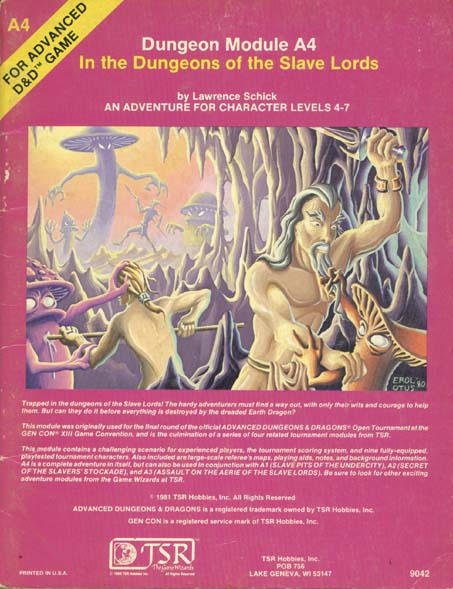
 (36) Slave Pits of the Undercity. 2 stars. David Cook, 1980. Levels 4-7. I never understood the love for the slavers modules; they shout mediocrity at every turn. Technically I should rank them in reverse order, as each gets slightly better, but that's damning with faint praise. Unlike #1-#34 on this list, I wouldn't run any of these for any reason. A big part of this has to do with the fact that they were scripted as tournament modules (notice the embarrassing fact that each is designed for the exact same level range, as if PCs never move up), but mostly they're just plain uninspired. The slave lords themselves have colorful personalities (when you reach them in the last two modules), and there are a few nifty encounter areas here and there, but most of the dungeon crawling is a big yawn. The best parts can be summarized thus: in A1, the ant-like aspis; in A2, the abandoned section of the stockade inhabited by a madman whom the slavers believe to be a ghost (a wonderfully insane idea that only Moldvay could come up with); in A3, the showdown with the slavers who have been observing the PCs for a long time through a crystal ball and will probably kill them, and then raise them from the dead for interrogation; in A4, the myconids, or mushroom men, depicted wonderfully on the pink cover art by Erol Otus. That exhausts my accolades for the slavers quartet, and I simply copy this commentary under each of the four entries.
 (37) Secret of the Slavers Stockade. 2 stars. Harold Johnson & Tom Moldvay, 1981. Levels 4-7. I never understood the love for the slavers modules; they shout mediocrity at every turn. Technically I should rank them in reverse order, as each gets slightly better, but that's damning with faint praise. Unlike #1-#34 on this list, I wouldn't run any of these for any reason. A big part of this has to do with the fact that they were scripted as tournament modules (notice the embarrassing fact that each is designed for the exact same level range, as if PCs never move up), but mostly they're just plain uninspired. The slave lords themselves have colorful personalities (when you reach them in the last two modules), and there are a few nifty encounter areas here and there, but most of the dungeon crawling is a big yawn. The best parts can be summarized thus: in A1, the ant-like aspis; in A2, the abandoned section of the stockade inhabited by a madman whom the slavers believe to be a ghost (a wonderfully insane idea that only Moldvay could come up with); in A3, the showdown with the slavers who have been observing the PCs for a long time through a crystal ball and will probably kill them, and then raise them from the dead for interrogation; in A4, the myconids, or mushroom men, depicted wonderfully on the pink cover art by Erol Otus. That exhausts my accolades for the slavers quartet, and I simply copy this commentary under each of the four entries.
 (38) Assault on the Aerie of the Slave Lords. 2 stars. Allen Hammack, 1981. Levels 4-7. I never understood the love for the slavers modules; they shout mediocrity at every turn. Technically I should rank them in reverse order, as each gets slightly better, but that's damning with faint praise. Unlike #1-#34 on this list, I wouldn't run any of these for any reason. A big part of this has to do with the fact that they were scripted as tournament modules (notice the embarrassing fact that each is designed for the exact same level range, as if PCs never move up), but mostly they're just plain uninspired. The slave lords themselves have colorful personalities (when you reach them in the last two modules), and there are a few nifty encounter areas here and there, but most of the dungeon crawling is a big yawn. The best parts can be summarized thus: in A1, the ant-like aspis; in A2, the abandoned section of the stockade inhabited by a madman whom the slavers believe to be a ghost (a wonderfully insane idea that only Moldvay could come up with); in A3, the showdown with the slavers who have been observing the PCs for a long time through a crystal ball and will probably kill them, and then raise them from the dead for interrogation; in A4, the myconids, or mushroom men, depicted wonderfully on the pink cover art by Erol Otus. That exhausts my accolades for the slavers quartet, and I simply copy this commentary under each of the four entries.
 (39) In the Dungeons of the Slave Lords. 2 stars. Lawrence Schick, 1981. Levels 4-7. I never understood the love for the slavers modules; they shout mediocrity at every turn. Technically I should rank them in reverse order, as each gets slightly better, but that's damning with faint praise. Unlike #1-#34 on this list, I wouldn't run any of these for any reason. A big part of this has to do with the fact that they were scripted as tournament modules (notice the embarrassing fact that each is designed for the exact same level range, as if PCs never move up), but mostly they're just plain uninspired. The slave lords themselves have colorful personalities (when you reach them in the last two modules), and there are a few nifty encounter areas here and there, but most of the dungeon crawling is a big yawn. The best parts can be summarized thus: in A1, the ant-like aspis; in A2, the abandoned section of the stockade inhabited by a madman whom the slavers believe to be a ghost (a wonderfully insane idea that only Moldvay could come up with); in A3, the showdown with the slavers who have been observing the PCs for a long time through a crystal ball and will probably kill them, and then raise them from the dead for interrogation; in A4, the myconids, or mushroom men, depicted wonderfully on the pink cover art by Erol Otus. That exhausts my accolades for the slavers quartet, and I simply copy this commentary under each of the four entries.
 (40) Queen of the Demonweb Pits. 1 star. David Sutherland, 1980. Levels 10-14. This was my #1 favorite back in the day. That it can drop from the highest point to the lowest requires explanation, and the explanation is that it fails on every level -- design, concept, and premise. All of which was easy to overlook when suddenly given license to kill deities on their own plane, and of course what hormonal male wasn't aroused by the suggestive sketches of Lolth in her humanoid form? I should make clear that I don't have any theoretical problem with PCs killing deities: gods and goddesses are given statistics (armor class, hit points, etc.) implicitly for this possibility. But Lolth is too compelling a figure to allow to be killed off in this kind of adventure. Moreover, as I've written about here, the plotting of the giant-drow series doesn't require a trip to the Abyss, because Lolth isn't even the menace. (Her wayward priestess is the one trying to subjugate the upper world.) But what really offends me is the appalling design, which is basically a sci-fic dumbing down of the Abyss. I'm embarrassed that I liked the spider ship so much (no doubt riding the enthusiasm for Expedition to the Barrier Peaks, the once-in-a-blue moon case where sci-fic elements work in D&D); it's truly ludicrous. I'm sure that if Gary Gygax had finished his own series (he authored the G and D modules and was originally slated for this one), he would have come up with an appropriately abysmal domain fitting the queen of spiders -- labyrinthine caverns, halls of webbing, a deeply horrific atmosphere, etc. Dave Sutherland was clueless.
Mixed in with the TSR classics are others I feel compelled to include: four Judges Guild modules, two from Dragon magazine, and a special module published recently by the guru of old-school RPGs, James Maliszweski. If not for James and his Grognardia blog, I doubt my passion for D&D would have ever been reignited.
 (1) Tomb of Horrors. 5+ stars. Gary Gygax, 1978. Levels 10-14. The mother of all killer dungeons is revered by everyone, even victims who insist otherwise. It gave DMs a license to be ridiculously unfair and players the okay to be masochistically thrilled by impossible challenges. You really have to embrace the futility of going against the demi-lich, provided you can reach that point, which is highly unlikely. Multi-layered traps and demonic snares are in play everywhere, and some of the rooms have acquired mythic status: The Forsaken Prison, The Chapel of Evil, The False Crypt, The Chamber of Hopelessness. I get chills thinking of them and the disturbing illustrations provided in the special booklet. No other dungeon has called forth the level of commentary that continues to this day, ranging from the outraged to the venomous to the heapingly sarcastic (my favorite is the cover parody carrying the label "For Advanced Sadists & Masochists"), but what's interesting is that the only reason Tomb of Horrors even exists is because players were complaining that the game was getting too easy. It's hard to imagine how D&D would have evolved if not for those complaints, but there's no question that Gygax is remembered for his response to them, this module, more than any other. When he died in 2008, it was even suggested as a tribute to start a fund for a mausoleum based on the tomb's layout, and I can't imagine a more appropriate honor. The '90s sequel, Return to the Tomb of Horrors, is frankly just as good (and twice as deadly), and may be considered an honorary tie at first place.
 (2) The Lost City. 5+ stars. Tom Moldvay, 1982. Levels 1-3. A close second on my list, and I could almost award it the top slot for being a beginner's module. It's hard to come up with top-notch low-level adventures, but The Lost City is so inspired that I never resented the fact that the city itself leaves much for the DM to develop; I bought into the pyramid so much that the rest flowed without thinking. The module in many ways epitomizes what the Golden Age of D&D had to offer: pulp fantasy at its purest, depicting an ancient underground civilization that's been corrupted by a Cthulhu-like deity monster. The three renegade factions adhere to the old gods, but they don't like each other, and are capable of using the players as pawns. The revolving passage on the third tier of the pyramid is one of my favorite dungeon features, and the personalities of the cult leaders, their costume attire and masks, are spot on, meshing perfectly with the decadent civilization of the Cynidiceans. The influence of Howard's Red Nails is often talked about, and the hallucinogenic drug-addicted devotees of Zargon are exactly the sorts Conan would find himself going against. I'll never forget my friend's reaction when his characters confronted the high priest beside the underground lake, and I had the fanatic cast an earthquake spell. (I think he thought I was as psychotic as the priest.) There is endless potential in The Lost City for follow-up adventures, and at one point I harbored ambitions to develop an entire series out of it.
 (3) Castle Amber. 5 stars. Tom Moldvay, 1981. Levels 3-6. Another Moldvay treasure, but in this one I was the player. The Amber family are a lot like a warped version of Tolkien's elves: "The Ambers live magically lengthened lives, but they have seen too much and are bored. They seek anything to relive this boredom." Equally amused by the success or deaths of anyone working against them (for "a good spectacle" is more important than victory or defeat), their chaotic indifference disturbs more than the evil of traditional foes. No other module on this list boasts so many colorful and psychotic characters: the librarian Charles who buried his sister Madeline alive; the soul of Princess Catherine waiting to possess someone; the evil priest Simon; Madam Camilla who is itching to tell fortunes. Also, no other module offers so much with such effortless economy. First, there's the castle itself, with two large wings, an indoor forest, and a chapel, and not a room is wasted; second comes a challenging dungeon with well planned surprises, ending at a magical gateway to -; third, the old home of the Ambers on an alternate prime material plane resembling medieval France, where the players must acquire four artifacts to return to - ; fourth, the tomb of Stephen Amber himself, where lies the means to break the curse of the castle. Moldvay hit a home run like he did with The Lost City, and I would probably call Castle Amber the most rewarding D&D adventure I ever experienced as a player.